
What plastics are made of, how thermoplastics, thermosets and elastomers differ, and why injection moulding almost always uses thermoplastics.
In industry, plastics have replaced many parts once made of metal, glass and wood. They are lighter and can be formed into shapes that would be expensive or impossible to make in metal. Anyone who buys or designs plastic parts still needs to know what they are working with. Not every plastic can be injection moulded, and not every mouldable plastic can handle what the part will face in service. That is why choosing the right material plays a big part in how well a component performs in use.
What plastics are made of
Plastics are organic materials made of long molecular chains called polymers. They are produced synthetically or semi-synthetically: small building blocks, the monomers, link up into chains through chemical reactions. The raw material usually comes from crude oil or natural gas. The choice of monomers and the way the plastic is processed determine its properties. The same base material can end up hard or elastic, crystal clear or opaque.
Thermoplastics, thermosets and elastomers
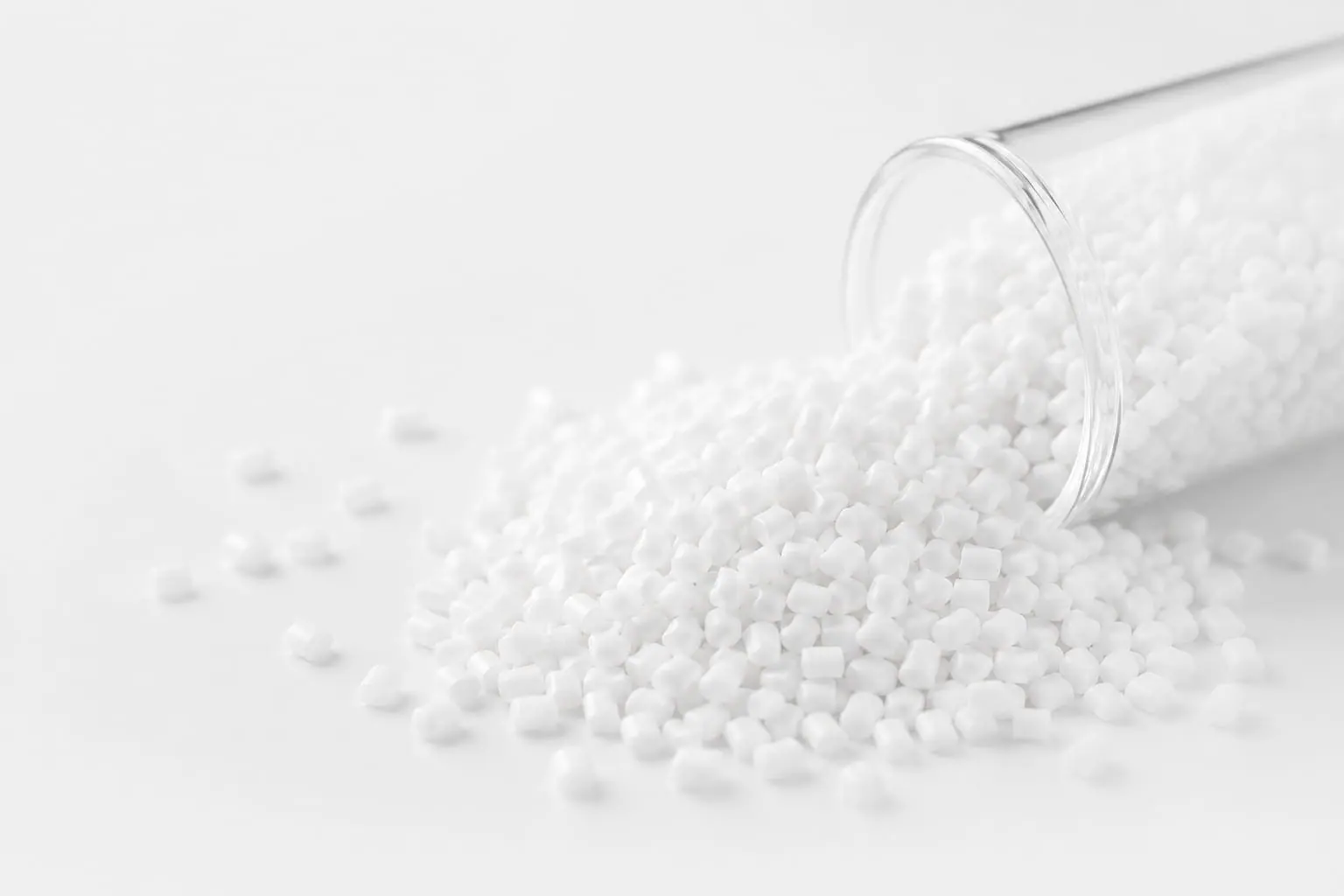
 Thermoplastics soften when heated and harden again when cooled, without changing chemically. This can be repeated any number of times, which is why they suit injection moulding. Examples: PE, PP, ABS, PA, PC, POM.
- Thermosets cross-link permanently as they cure and cannot be melted again afterwards. They are used in electrical engineering, circuit boards and automotive manufacturing, for example as epoxy or phenolic resin.
- Elastomers are rubber-like. They stretch a long way and then return to their original shape. Typical parts are seals, tyres and vibration dampers.
Why injection moulding almost always runs on thermoplastics
In injection moulding, a thermoplastic is melted, injected into the mould under pressure and cools there. The part is then ejected and the next cycle begins. Because the material does not change chemically, every shot produces the same part, even after millions of cycles. Sprues can be ground up and reprocessed. In our moulding shop, more than 30 Arburg machines with 30–250 t clamping force do this work.
What makes plastics suitable for technical parts
- Low weight with high specific strength, important in automotive and aerospace
- Resistant to corrosion and to many acids, alkalis and oils
- Electrically insulating, which makes them standard in electrical engineering and electronics
- Almost any shape is possible: undercuts, threads and ribs are moulded in directly
- Large series with consistent dimensions at low unit cost
Which thermoplastic for which part?
For injection moulded parts, the choice almost always comes down to a thermoplastic. PP, ABS, PA and POM differ considerably in strength, temperature range and price. The next article shows how they compare. If you already have a specific part in mind, send us a drawing or sample and we will suggest a suitable material.
Get Started
Ready for Your Next Project?
Get in touch. We will advise you on your component, the right material and the optimal manufacturing process.